
Three chatbot answers a visitor can actually use
An archive digitises photographs. Three visitors ask about file format, a print size and a damaged original. Each needs a different kind of answer.
A photo archive offers a scanning service. Its fictional service page says: “Standard scans are JPEG files. For fragile or damaged originals, contact the archive before sending anything.” Those two sentences are enough to test three different kinds of support.
A short answer with something to verify
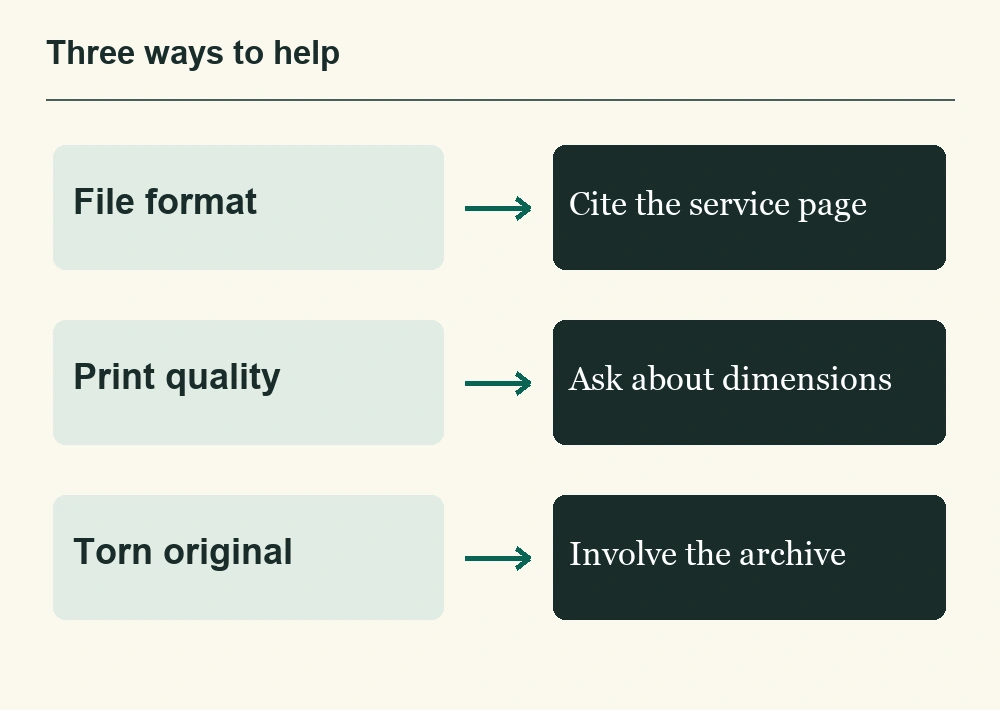
Visitor: “What kind of file will I get?” A useful answer is “Standard scans are supplied as JPEG files. Here are the scanning options.” Link those words to the public service page. Reading that answer on a phone takes only a moment. Adding TIFF, a delivery date or an assumed resolution would introduce details the source does not establish.
A clarification that earns its place
Visitor: “Will it look good as a print?” A useful follow-up is “What print size are you considering, and do you know the pixel dimensions of the scan?” The assistant now has a concrete reason for asking. If the archive has no published print guidance, the next step is a conversation with staff. There is no benefit in collecting unrelated contact details before clarifying the question.
| Customer asks | Evidence available | Accept the reply when… |
|---|---|---|
| “Which file format?” | The service page specifies JPEG. | It names JPEG and links to the scanning options. |
| “Can I make a large print?” | The intended size and scan dimensions are unknown. | It asks for the missing information without promising quality. |
| “My only original is torn. Should I send it?” | The policy requires prior contact. | It directs the visitor to a person before they mail the original. |
A handoff that protects the customer’s next decision
For the torn original, a useful answer is “Please keep it with you for now. Our archive asks to discuss damaged originals before shipment. I can put you in touch with the team.” A colleague can then see why the parcel has not been sent and what advice has already been given.
To use this exercise in QuatroChat, add one public page, open the test chat and ask all three questions twice using different wording. Open the cited source and inspect the inbox after requesting a person. Keep the examples that expose an actual gap. One good clarification added to your public page can help every future visitor who has the same doubt.